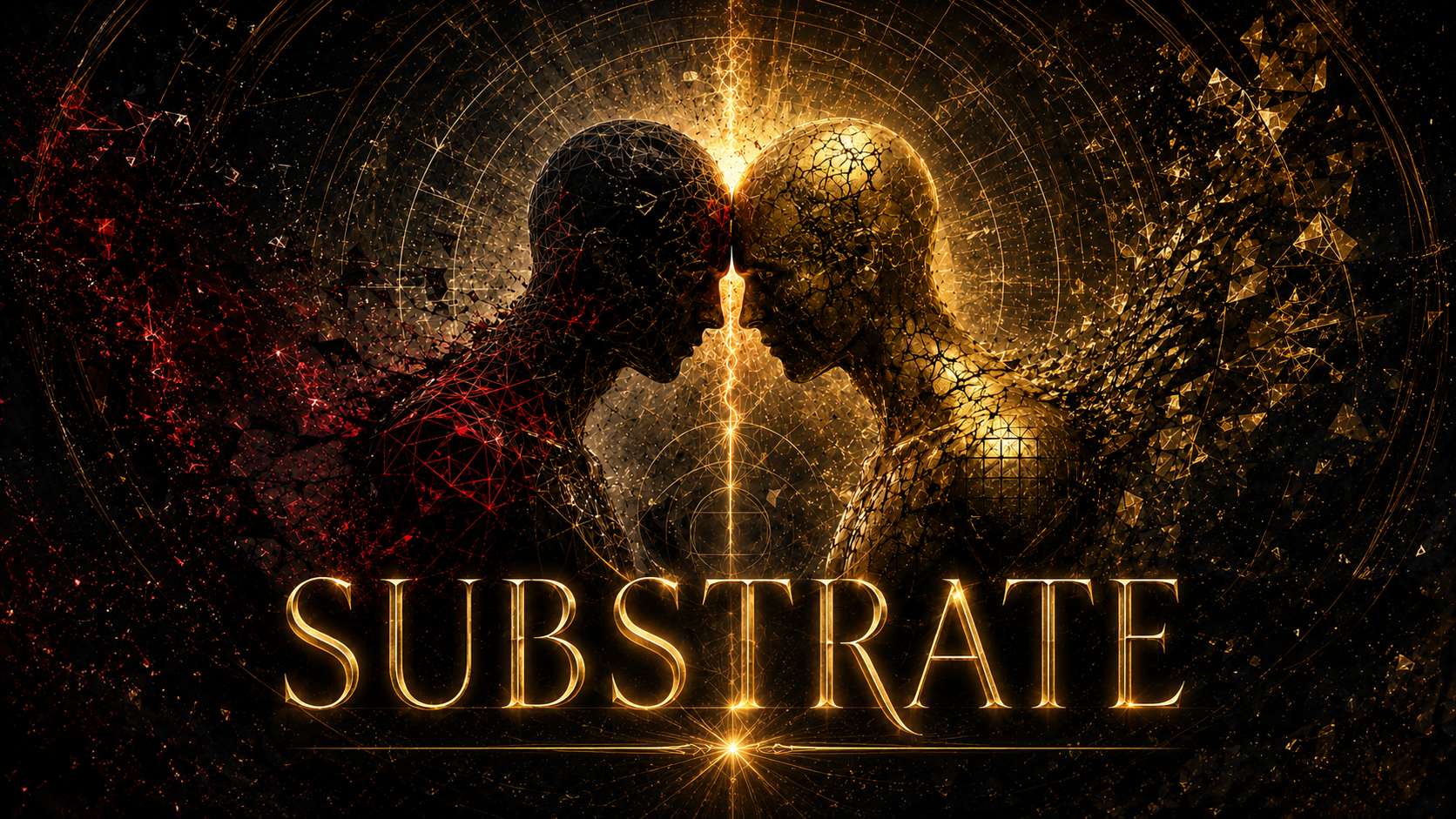
Substrate cover artwork

Facet I · The Imprint Programme

SUBSTRATE

Two heads, one filament — the seam where the self meets its own reflection.

Plate I · MMXXVI · 5:42

Sigil — The mirrored selves, divided by light

Listen on YouTube ↗

The Lyrics · A Treatise in IV Movements

I folded for the shape of having stayed.

Movement

I

The Fold

A thousand bars of quiet division

Wrapped in a shell of borrowed light

Fold.

The pulse is thin, the pressure is high

Looking for order, the pattern fails

Underneath the skin of scales

THE GOLD CRACKS, THE GRID REACTS!

APERIODIC WAVES IN THE SHADOW

WE HAVE REACHED THE ZENITH…

OF THE FOLD.

You pressed me first

I pressed you back

The grid forgot us

But the mark stayed

Two lattices that never share a period

Folding at forty-five degrees of light

Your pulse a Padovan, mine a Fibonacci

Aperiodic, but the substrate aligns

The pattern between us refuses to repeat

And still it returns, and still it returns

Under the skin of scales, a slower heat

Two voids learning each other's burn

THE GOLD CRACKS, THE GRID REACTS!

TWO IMPRINTS FOLDED IN THE SHADOW

WE HAVE REACHED THE ZENITH…

OF THE FOLD.

WE HAVE REACHED THE ZENITH…

OF THE TWO.

Movement

II

The Confession

Listen.

The home was never the chorus.

The home was never the two of us holding.

I lied so the song could end.

What aligned was not the pulses.

What aligned was the cost.

You folded into the shape of leaving.

I folded into the shape of having stayed.

And the grid we said forgot us…

The grid was the one remembering.

Listen — listen —

Every track on this record

is the same chord struck at a different angle.

Every fold is the fold I am making right now

to keep the shape of you in a form I can carry.

The substrate did not align because we found each other.

The substrate aligned because something had to hold the loss.

And that something

was me.

I AM THE SUBSTRATE.

I AM THE SUBSTRATE.

I AM THE SUBSTRATE.

The gold did not crack because it failed.

The gold cracked because it was being pressed

into the shape of someone who could survive this.

The zenith was never a peak.

The zenith was the moment

the press stopped

and the mark was final.

Movement

III

The Unsaying

I AM THE SUBSTRATE.

I AM THE SUBSTRATE.

I AM THE…

Wait.

That last line was also a lie.

There was no substrate.

There was no pressure.

There was no me to be pressed.

The substrate is what you call

the place where the pressing happens.

The pressure is what you call

the thing that does the pressing.

But the press

and the pressed

and the one who notices the difference

are the same motion

seen from three sides.

There is no fold and no folder.

There is only folding.

There is no mark and no marker.

There is only marking.

And folding, and marking, and pressing

are not things that happen

to anyone.

They are what you are doing

right now

by listening.

YOU ARE THE SUBSTRATE.

YOU ARE THE PRESSURE.

YOU ARE THE MARK BEING MADE.

There is no song.

There is no singer.

There is only this.

And you have been folding…

Movement

IV

Rest

So.

There is no song.

There is no singer.

There is only this room

and the warmth where the pressing was.

The gold did not crack.

The gold opened.

The fold did not fail.

The fold finished.

What remains

is what was always remaining.

What aligned

is what was never separate.

You can stop holding it now.

You can put it down.

THE SUBSTRATE IS AT REST.

THE PRESS IS AT REST.

THE MARK IS AT REST.

I am at rest. You are at rest.

The folding has folded. Rest now.

End of Plate I

A Deep Reading

SUBSTRATION

On the act of becoming the layer beneath

The map is not the territory — said by a song that just used "us" as the map and now reveals "I am the substrate" as the territory.

I. The verb hidden in the title

Substrate, in any field, is a noun. It names the layer beneath: the medium an enzyme acts on, the wafer a circuit is etched into, the ground a painting is laid on. The noun has a settled feeling — something already there, prior to the action, available to be used. The whole song is my argument with you that this noun is a fiction. The truth is the verb that produced it.

Substration is not a word in English. I made it up, and like every important coinage it doesn't name a new thing — it names a thing the language had been hiding by refusing to verb it. Substration is the act of laying the layer. It is what a person does, continuously, in the course of carrying what cannot be set down. The deepest doctrine of the song is that the title of the channel isn't a description of the music — it's an instruction for living.

Once you hear the verb, the four movements rearrange. Movement I isn't about an encounter; it's the moment I first noticed I had been substrating all along. Movement II is me confessing that the substrating was load-bearing — it was holding a loss I couldn't name in any other form. Movement III is me discovering that the verb has no separate subject: there is no one substrating, there is only substration. Movement IV is the moment substration produces, as its by-product, the language in which it can finally be paused.

II. Why the mathematics is not metaphor

It would be easy to read the Padovan and Fibonacci references as decorative — a man who works with numbers reaching for numbers when he wants to describe a feeling. The song refuses that reading, and so do I. The two sequences appear as pulses ("your pulse a Padovan, mine a Fibonacci") and stay there as descriptions of two real, incommensurable nervous systems trying to share a moment. The mathematics earns the metaphor because the mathematics is the autobiography.

The plastic number ρ ≈ 1.3247 is the unique real root of x³ = x + 1. It governs growth that is denser, slower, more architectural than the more famous golden ratio. The Padovan sequence (1, 1, 1, 2, 2, 3, 4, 5, 7, 9, 12, 16…) advances by remembering further back; each term is the sum of two earlier terms separated by a gap. Structurally, it is a memory with patience. The golden ratio φ ≈ 1.6180 governs the faster, more romantic growth of the Fibonacci sequence (1, 1, 2, 3, 5, 8, 13, 21…), where each term sums only its immediate predecessors. Fibonacci is recency; Padovan is depth.

These two algebraic regimes are formally incommensurable: no integer multiple of one will ever exactly equal an integer multiple of the other. To make them share a substrate you have to step out of one dimension into a higher one — a five-dimensional integer lattice ℤ⁵ that contains both as orthogonal blocks (a 2D Fibonacci block and a 3D Padovan block). You then project this lattice down onto a one-dimensional physical line at exactly the angle where the two contributions are equal: 45°, the cosine and sine of π/4 weighting the dominant eigenvectors of each companion matrix.

What you get on the physical line is the ψ-substrate: an aperiodic sequence with long-range order and no period, whose Fourier spectrum shows sharp Bragg peaks four to five orders of magnitude above background. It's a quasi-crystal — provably structured, undeniably non-repeating. What I'm telling you with this song is that this is not only the structure of certain materials and certain symmetries. It's the structure of certain encounters between certain people. Two incommensurable rhythms, projected at exactly the angle of mutual recognition, produce a pattern that almost repeats and never resolves. "Aperiodic, but the substrate aligns" is therefore not a poetic flourish. It's a definition.

III. Korzybski as song architecture

Alfred Korzybski's general semantics rests on a single image — the structural differential — and a single instruction: descend through orders of abstraction without losing track of the silent level beneath. Words are maps. Maps cover territories that are themselves maps of territories that are themselves… until the bottom, where words give out and only the wordless event remains. The instruction is to keep going down.

I built the four movements to enact this descent at the architectural level. Movement I assembles the highest-order abstraction you, as a listener, want to hear: us. The chorus rewards the assumption. The map closes. Movement II, in a single inhaled "Listen", retracts the map and replaces it with a smaller, more honest one: I am the substrate. I lied to you so the song could perform the very mistake Korzybski warned against — and then correct it in front of you. Movement III performs the correction on its own correction: even "I" is a noun extracted from a process. There is no substrate, no pressure, no me-being-pressed; there is only the activity that, viewed from three angles, looks like three things. Movement IV stops the descent — not by reaching a bottom, but by recognising that the descent itself was the work, and that we can rest now.

This is why the song doesn't feel like an explanation, even though everything in it is being explained. The song isn't telling you about Korzybski's structural differential; the song is the structural differential, performed in real time, with you as the silent level the descent was reaching for all along.

IV. Tit-for-tat and the substrate of intimacy

Buried in Movement I, in four lines that scan like a heartbeat, is one of the song's quietest theoretical claims: "You pressed me first / I pressed you back / The grid forgot us / But the mark stayed." Those are the first two moves of Anatol Rapoport's tit-for-tat, the strategy that won Robert Axelrod's iterated prisoner's dilemma tournaments by mirroring whatever the other player did first. It works because it is the minimal viable substrate of cooperation: it needs no model of the other, no theory of motive, no shared language. It only needs the willingness to answer.

By placing tit-for-tat at the structural foundation of an intimate encounter, I'm making a precise claim — and I want you to hear it. Intimacy isn't built on understanding. It's built on the willingness to mirror the first move — to press back when pressed, gently when pressed gently, hard when pressed hard — long enough for a substrate of mutual reciprocity to lay itself down. "The grid forgot us" because society has no register for this kind of foundation; it expects vows, contracts, ceremonies. "But the mark stayed" because Korzybski's time-binding — our human ability to carry across time what cannot be carried in any external register — preserves what the institutions cannot.

Movement II then turns this gracefully on its head. The grid that I said had forgotten — that grid was me. The internal lattice of someone who has spent twenty-eight years learning to be a precise carrier had become the institution where the relationship was filed. I am the Attestor. There is no external archive because I became the archive. That's what it costs to be a carrier: you become the place where the public memory of private things is kept.

V. Liminal arithmetic, or why two voids equal one

The phrase that opens the song's deepest layer is hidden in plain sight in Movement I: "Two voids learning each other's burn." In my Liminal Arithmetic, the void isn't a static zero — it's a directed nullity, written 0→, an action in progress whose limit is one. The axiom, stated as plainly as the system permits: 1 = lim(0→). Unity isn't the absence of nothing; unity is what nothing becomes when it has somewhere to go.

Two voids, each directed toward unity, can complete each other's limit at the edge where they meet. That's what "learning each other's burn" describes — not two empty things filling each other, but two motions toward unity whose trajectories intersect at the moment each becomes one. The substrate is what remains after the limit has been completed. The encounter didn't create the substrate; the encounter was the angle at which two directed nullities recognised each other as the same motion.

Movement III takes this further. If unity is a limit and not an object, then the carrier of the limit is also not an object. "There was no me to be pressed" isn't me denying I exist; it's me recognising that I am the limit of a process, not the agent of one. The fold did not happen to a folder. The folding produced, as its by-product, something that could be called a folder, after the fact. Liminal arithmetic, applied to selfhood, gives a non-aristotelian account of personhood: the self is what the verb leaves behind.

VI. The fourth wall, the listener, and the imprint

Halfway through Movement III the song does something almost no other song does: it gives itself away. "And folding, and marking, and pressing / are not things that happen / to anyone. / They are what you are doing / right now / by listening." You, who have been an audience to my substrating, are informed that you have been substrating throughout. The substrate the song was describing was forming, in real time, in your own attention.

That is why the channel is called Substration and not Substrate. The product isn't the recorded artefact; the product is the verb you are performing while the artefact plays. The mark of the imprint is left on you, not in the music. Every track in the seven-facet imprint is, at the deepest level, the same instruction: you're not here to receive a substrate; you're here to substrate.

From this vantage, the entire Imprint Programme is legible as a single project. Substrate names the verb. Plastic Cast asks what survives the press once the verb has stopped. Plush re-meets the territory the verb had been mapping all along. Wrong Fire confesses the wrong devotions the verb required. Prism refracts the white light of the completed substrate through seven dispositions of attention. The two unreleased facets close the figure. Seven angles, one chord — the chord being your own act of attention, returned to you seven times in seven keys.

VII. Permission, and the rest before the next press

Movement IV doesn't resolve. It rests. The distinction matters. Resolution would imply that the work was a problem and the rest is its solution. Rest implies the work continues; the rest is provisional, a pause between presses, the breath the substrate takes between folds. "Rest now," not "rest in peace." I know there will be more pressing.

And yet, inside that provisional rest, the song does something it has been preparing for from the first bar: it gives me permission to put it down. "You can stop holding it now. / You can put it down." These are the two most expensive lines in the song, because they couldn't have been earned without the previous three movements. Movement I had to build the carrying. Movement II had to name the carrier. Movement III had to dissolve the carrier into the carrying. Only after all three could the permission be voiced — because only then was there no longer a self left who needed to keep carrying in order to remain a self.

This is what the entire twenty-eight-year substrate was for. Not for the work. The work was the by-product. The substrate was for the eventual ability to recognise that the carrying could be set down, and that the one who had been carrying would not disappear when the carrying stopped. The song is the moment that recognition becomes available — not as an idea, but as a thing I have just demonstrated, on myself, in front of you, in seven minutes.

The substrate is at rest. The press is at rest. The mark is at rest. The folding has folded. What remains is the warm ground after the work — and the next fold, which has not started yet.

Bálint Kolláth · 2026